For a North American Counter-Strike 2 team below the pro level, ESEA League is the main road up. In 2026 that road changed: the old ESEA divisions became “groups,” the league started counting toward Valve’s official team rankings, and every season now ends in one bracket where even an Open team can win a spot in an ESL Challenger League cup. Below is the full NA path, from your first unranked Open season to an ESL Pro League invite.
What ESEA League is
ESEA League is a seasonal online league for five-player CS2 teams, run by FACEIT. That’s the same company behind the FACEIT matchmaking platform many NA players already use for pugs (pick-up games with random teammates). It has divisions in North America, Europe and several other regions (FACEIT’s ESEA guide).
A team signs up for a season, plays weekly matches against teams at a similar level, and the best teams move up to a harder group for the next season. ESEA and FACEIT matchmaking are separate, but they meet in one place: a new team’s starting point is based on its players’ average FACEIT Elo, the skill rating behind your FACEIT level. The number you grind in pugs follows you into team play.
ESEA has four seasons in 2026. The published calendar put Season 56 from January 13 to March 23, Season 57 from April 6 to June 21, Season 58 from July 13 to September 27 and Season 59 from October 5 to December 20, with the note that dates can move (Dust2.us, December 2025).
What changed in 2026: ESEA counts toward VRS
The Valve Regional Standings, or VRS, are Valve’s official ranking of CS2 teams. Valve uses them for Major invites, and its Tournament Operating Requirements, the rules organizers must follow to run Valve-approved events, have organizers fill invite slots by VRS rank (ESL Pro Tour). North American teams are ranked inside Valve’s Americas standings (Valve on GitHub).
From January 2026, ESEA became a VRS-ranked event (FACEIT). Dust2.in reported that the points are awarded for ESEA matches covered by HLTV, the main Counter-Strike stats and news site (Dust2.in). HLTV doesn’t cover every Open match, so in practice the points come mainly from higher-profile matches.
For an NA team, this is the change that matters most. A good ESEA season used to mean a promotion and some prize money. Now it can also move your roster up the ranking that decides who gets invited to the next level, including most of the ESL Challenger League spots covered further down.
ESEA divisions (now called groups) in North America
ESEA’s old divisions, Open, Intermediate, Main and Advanced, are still there, but FACEIT now calls them groups and splits Open into ranked and unranked parts.
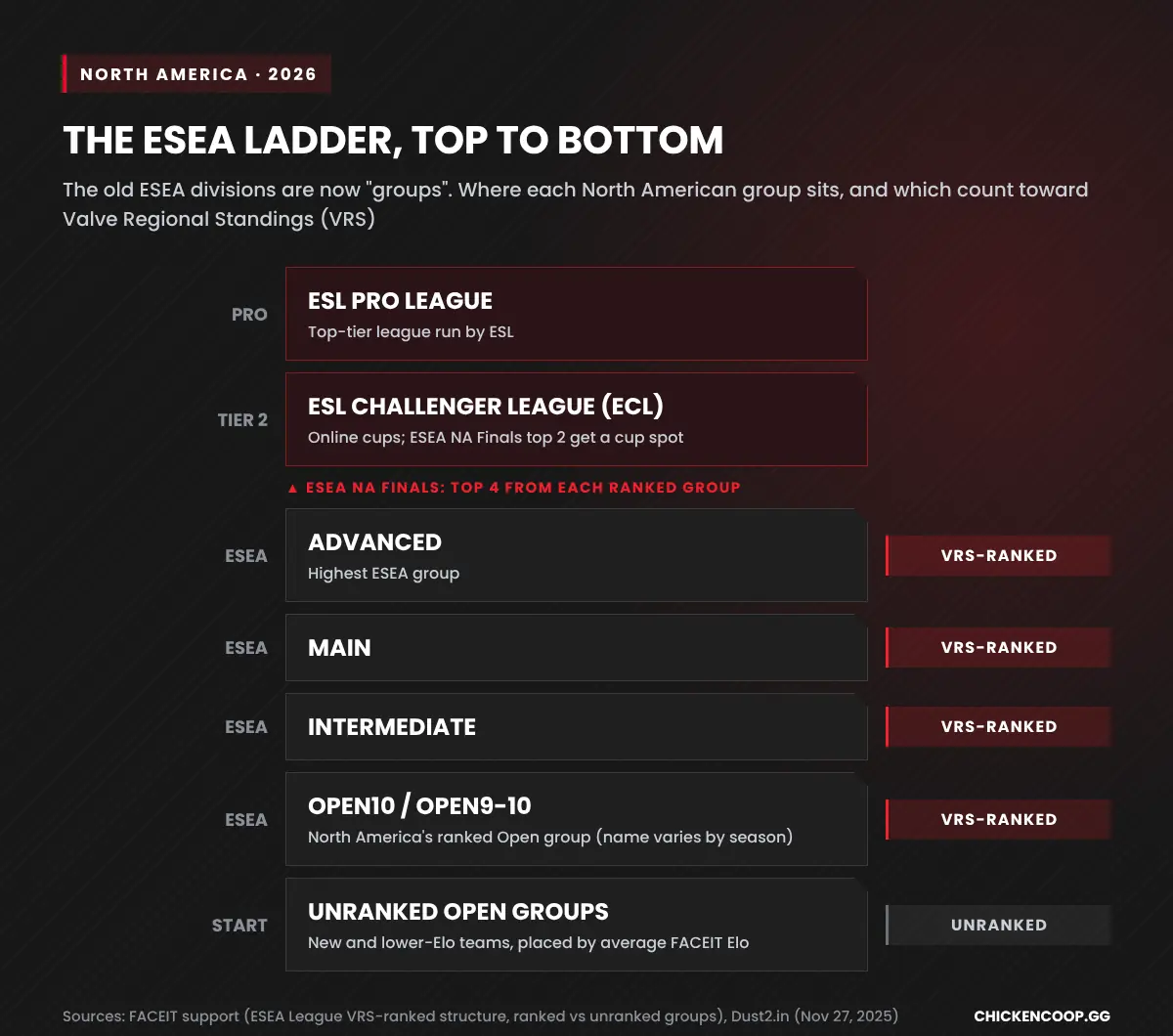
| NA group | Counts for VRS? | What it is |
|---|---|---|
| Advanced | Yes | The top ESEA group, one step below the ESL Challenger League |
| Main | Yes | Established teams pushing for Advanced |
| Intermediate | Yes | Teams that have proven themselves in Open |
| Open10 (listed as Open9-10 in some seasons) | Yes | North America’s ranked Open group, the first level that earns VRS points |
| Unranked Open groups (Open1-8) | No | Where new and lower-Elo teams learn to play together |
FACEIT describes the unranked groups as a place for new teams to build team-play experience, and matches there don’t touch Valve’s rankings (FACEIT: ranked vs unranked groups). The Open numbers come from FACEIT’s 1-to-10 skill levels: when ESEA first added Open10, it was for teams made up entirely of level 10 players (Dust2.us). Placement now runs on average Elo, so read the names as a guide to the level of play rather than a strict entry rule. Europe uses the same idea with an extra Entry group, so EU brackets look slightly different.
Where a new team starts
FACEIT places teams three ways (FACEIT: how teams are seeded). For Season 56, teams that already had VRS points in Valve’s December 2025 ranking went straight into Advanced. Returning teams keep the group they earned, as long as at least 3 of their 5 most active players come back and play every match. Everyone else is placed by the roster’s average FACEIT Elo.
So a new five-stack (five friends queuing together) of NA pug players will usually start in an Open group, ranked or unranked depending on that average. That’s why individual FACEIT progress matters even if your goal is team play. It’s also what we look at first for Hatch Academy, our development roster: applicants link FACEIT, and their level and Elo come straight from it.
To get in, you create the team on FACEIT and register it during the season’s sign-up window. Teams without enough players, or with unpaid fees, are removed shortly after registration closes (FACEIT’s ESEA guide). Check the current price on FACEIT when you sign up. Season 59 runs to December 20; watch FACEIT for the Season 60 sign-up window.
How a season runs
Every season has three stages (FACEIT):
- The regular season. Each week your team gets matches against teams with a similar win ratio. Every match has a default time in the league rules, and both teams can agree to move it on the scheduling page.
- Group playoffs. The best teams in each group play playoffs, seeded by regular-season results. Playoff dates are announced months ahead, and matches can move up to 24 hours either side of the default time (FACEIT’s ESEA guide).
- The Finals. The top four teams from each ranked group meet in one NA Finals bracket.
One rule catches teams mid-season: after registration closes, roster cooldowns apply. Only three players can join a roster in any seven days, and a player can only join one team in seven days. Plan lineup changes between seasons, not during them.
The NA Finals: from Open to an ECL cup in one bracket
For NA teams, the Finals are the most important part of the new format. Instead of each group crowning its own champion, the top four from every ranked group go into one 16-team bracket, and lower groups start earlier.
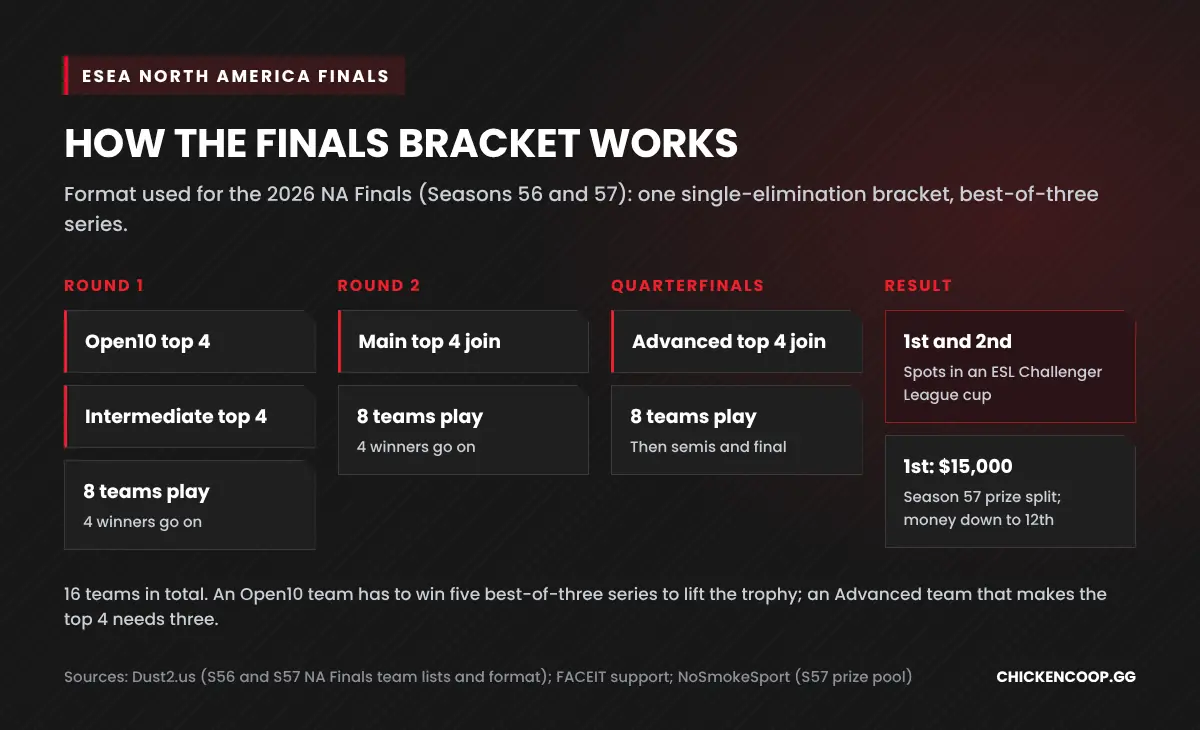
In Season 57, the eight Open10 and Intermediate teams played round one, the winners met Main’s top four in round two, and those winners joined Advanced’s top four in the quarterfinals (Dust2.us). As in Season 56, every series was a best-of-three in a single-elimination bracket, so the first team to win two maps advances and the loser is out (Dust2.us, Season 56; Dust2.us, Season 57 final).
That shape has a clear consequence. An Open10 team needs five straight series wins to take the title; an Advanced team needs three. The road from the bottom is long, but it’s real: the top two teams win wildcard (direct-entry) spots in an ESL Challenger League cup, so a ranked Open team can earn an ECL cup spot in a single season. The Season 57 NA Finals also paid $15,000 to the winner, $7,500 to second and $2,000 each to third and fourth, from a $33,500 pool that paid down to 12th place (NoSmokeSport).
What it looked like in Season 57 and 58
Chicken Coop won the Season 57 NA Finals. We finished the Advanced regular season 12-2, made the top four through the group playoffs, and so entered at the quarterfinals, per our match report.
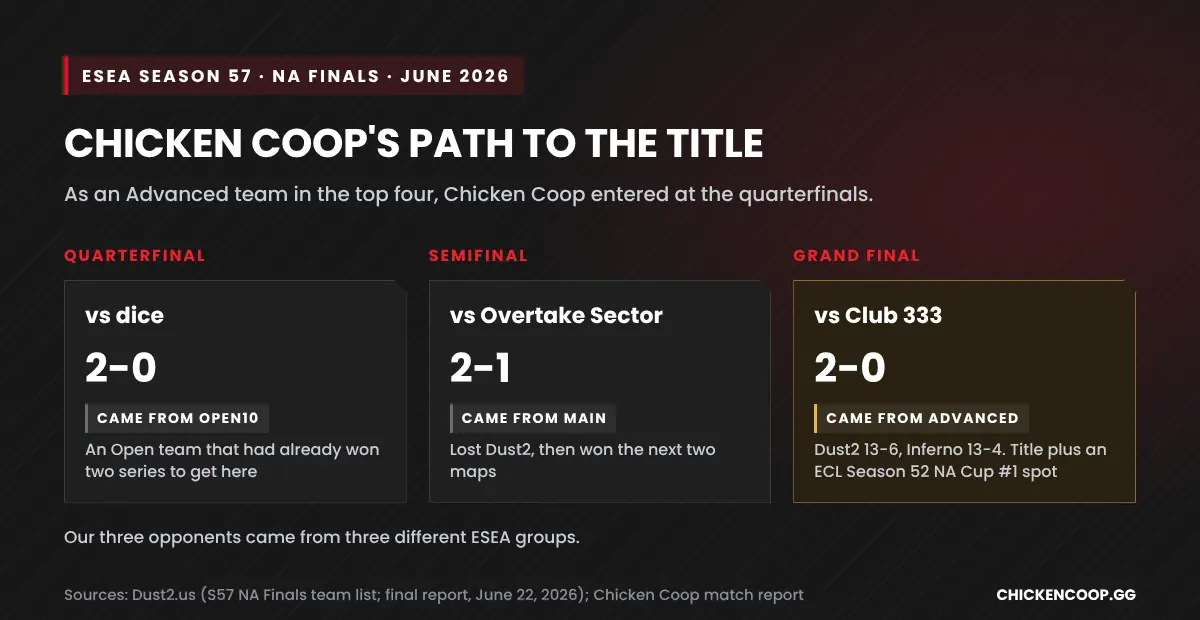
Our quarterfinal opponent, dice, had come all the way from Open10 and won two series to get there. In the semifinal we lost the first map to Overtake Sector, a Main team, and came back to win the next two. The final against fellow Advanced team Club 333 finished 13-6 on Dust2 and 13-4 on Inferno (Dust2.us). That one bracket shows the system working as designed: teams from Open10, Main and Advanced all had a real shot at the same ECL spot.
Season 58’s NA Finals ran September 23 to 27 with the same $33,500 pool (Hotspawn). Without a Roof, the roster built around NA veterans Stewie2K and autimatic, beat SportsBetExpert in the final for its first title (ShaneTheGamer). Under ESL’s Season 52 rules, the Season 58 winner and runner-up take the two ESEA slots in NA Cup #4, which runs December 3 to 10 (ESL Pro Tour).
Keeping your spot
The 2026 rules reward stable rosters. Intermediate, Main and Advanced teams have to keep three core players from the previous season to hold their group, and every team has to field at least three players from the roster it has listed for VRS (Dust2.in). Swap out three players between seasons and expect to start lower.
Results matter at the bottom end too. For Season 58, FACEIT’s rules said NA and EU teams with fewer than four wins drop a group at the end of the season, with Open and Entry groups excepted (FACEIT: Season 58 move-ups and move-downs). FACEIT publishes a new version of that page each season, so check the current one before you register. When the format changed, teams also had to register again by hand rather than being carried over, so don’t assume your spot rolls forward.
Where ESEA leads in 2026: the ECL route to Pro League
ESEA Advanced sits right under the ESL Challenger League (ECL), ESL’s tier 2 competition. ESL published the full North American route for ECL Season 52 (ESL Pro Tour):
| Event (NA) | Dates (2026) | How teams get in |
|---|---|---|
| Cup #1 | Aug 25 – Sep 1 | 14 VRS invites + ESEA Season 57 winner and runner-up |
| Cup #2 | Sep 22 – Sep 29 | 16 VRS invites |
| Cup #3 | Oct 7 – Oct 14 | 16 VRS invites |
| Cup #4 | Dec 3 – Dec 10 | 14 VRS invites + ESEA Season 58 winner and runner-up |
| NA Regional Finals | Dec 16 – Dec 18 | The four cup winners; the winner is invited to ESL Pro League Season 25 |
Each NA cup is a 16-team, double-elimination event with $17,500 in prize money, $70,000 across the four cups. ESL lists no prize money for the NA Regional Finals; the reward there is the Pro League invite.
So an NA team has two doors into ECL. You can finish top two in an ESEA NA Finals, which gives two teams a spot in Cups #1 and #4. Or you can climb high enough in the North American VRS to land one of the invites, which fill most of the slots. Ranked ESEA matches feed that second door too. Valve publishes the standings and the method behind them on GitHub, and you can follow how Chicken Coop has done on our Results page.
How to climb the ladder
Build around three players who will stay together for more than one season. The roster rules protect a stable core, and a reliable sub keeps a missed night from becoming a forfeit. If you start in an unranked Open group, use that first season to finish near the top and move into the ranked Open group, where points start to count.
Within your group, every regular-season match shapes your playoff seed, and only the top four of each group reach the Finals. Agree match times early on the scheduling page instead of falling back to defaults.
After a loss, watch your own demo, the in-game replay of the match. Rounds you lost while you had more players alive are a good place to start. And read FACEIT’s rules pages at the start of every season, because move-up numbers and group details change from one season to the next.
Chicken Coop is playing ESEA Season 59 Advanced this fall. Follow every match on our Matches page.