For a lot of competitive North American CS2 players, FACEIT is the number they measure themselves by. It’s also what ESEA uses to place new teams and what our own Hatch Academy reads when players apply. This guide covers what each FACEIT level means, how Elo actually moves, why the top of the NA ladder is more reachable than it looks, and what to train if you’re stuck below Level 10. Player counts are from CSDB.gg’s July 2026 count of the official FACEIT rankings.
How FACEIT levels and Elo work
FACEIT is a third-party matchmaking platform for CS2 with its own anti-cheat and its own ranking. Every player has an Elo rating, a number that goes up when you win and down when you lose, and that number places you in one of ten skill levels (FACEIT support).
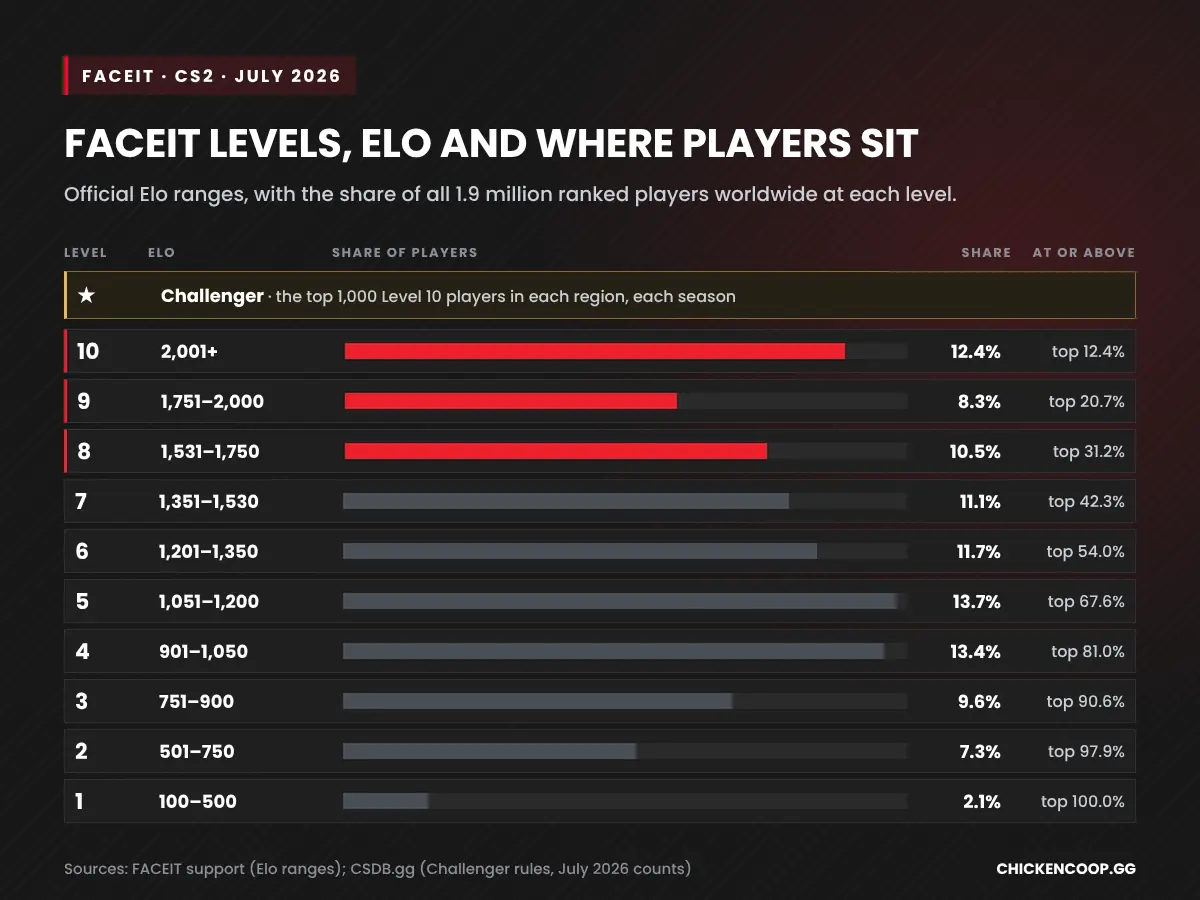
A few rules matter more than the table. New players start at 1,000 Elo, or get a starting number converted from their most recent Premier rating (CS2’s built-in ranked mode) if they meet FACEIT’s requirements (FACEIT support). Wins and losses usually move you somewhere around 20 to 50 Elo, depending on how strong your team is expected to be against the other one, and FACEIT Elo doesn’t decay or reset (CSDB.gg). Because Elo never decays, there’s no reason to protect a number by not playing. And because the swing depends on how your team matches up, a steady party you trust is worth more than extra solo games.
Level 10 has no ceiling. Above it sits Challenger. FACEIT describes it as the top 1,000 players at Level 10 (FACEIT support). CSDB.gg, which tracks the rankings, says the badge is awarded per region each season and is positional, so you hold it only while you stay in your region’s top 1,000 (CSDB.gg).
FACEIT Challenger: why the top of the NA ladder is closer than it looks
Europe dominates FACEIT’s player base, so the percentile numbers you usually see mostly describe European players. North America is a different ladder. In July 2026, FACEIT’s rankings had 75,282 ranked players in NA against 1,680,850 in Europe, and 9.7% of NA players were Level 10 compared with 12.9% in Europe (CSDB.gg).
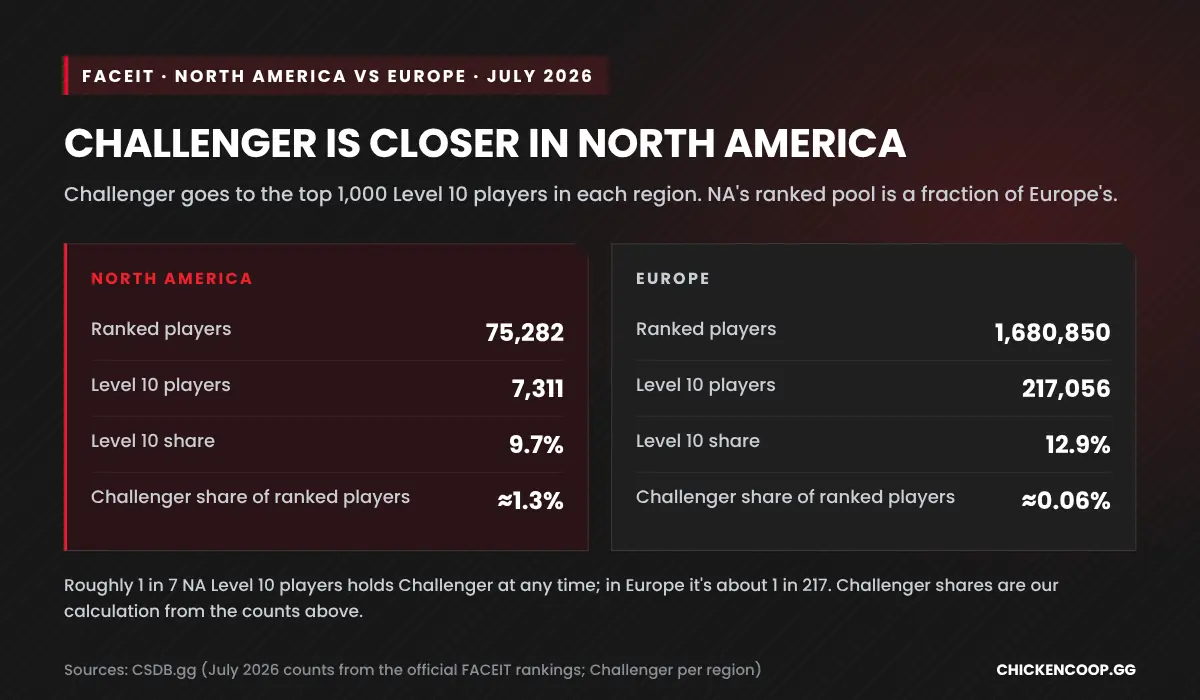
Because every region gets the same 1,000 Challenger spots, the badge is far more reachable here. By our calculation from those counts, Challenger is roughly the top 1.3% of ranked NA players, or about 1 in 7 NA Level 10 players. In Europe it’s about 1 in 217. If you’re a solid NA Level 10, Challenger is a realistic season goal, not a fantasy.
It matters beyond bragging rights. Region rankings are how the platform surfaces its best players. FACEIT Pro League (FPL) is the platform’s top tier. Its qualification guide, written for Season 5, made players in the top 15 of their region’s Elo rankings who weren’t already in FPL eligible for a two-week trial (FACEIT support). That guide is from an earlier season, so check FACEIT’s current FPL rules. What it shows is that FACEIT has used the regional ranking, not the level badge, to decide who gets invited up.
What separates FACEIT Level 10 from Levels 5 to 8
Refrag, a CS2 training platform, compared its users at Level 10 with those at Levels 5 to 8 and sorted the stats by the size of the gap. Three stood out (Refrag, July 2026). These are averages from players who use Refrag’s coaching tool, not all of FACEIT, and they show what Level 10 players do, not proof that these habits alone get you there. Refrag didn’t break out Levels 8 and 9 separately, so treat these numbers as a guide for anyone below 10.
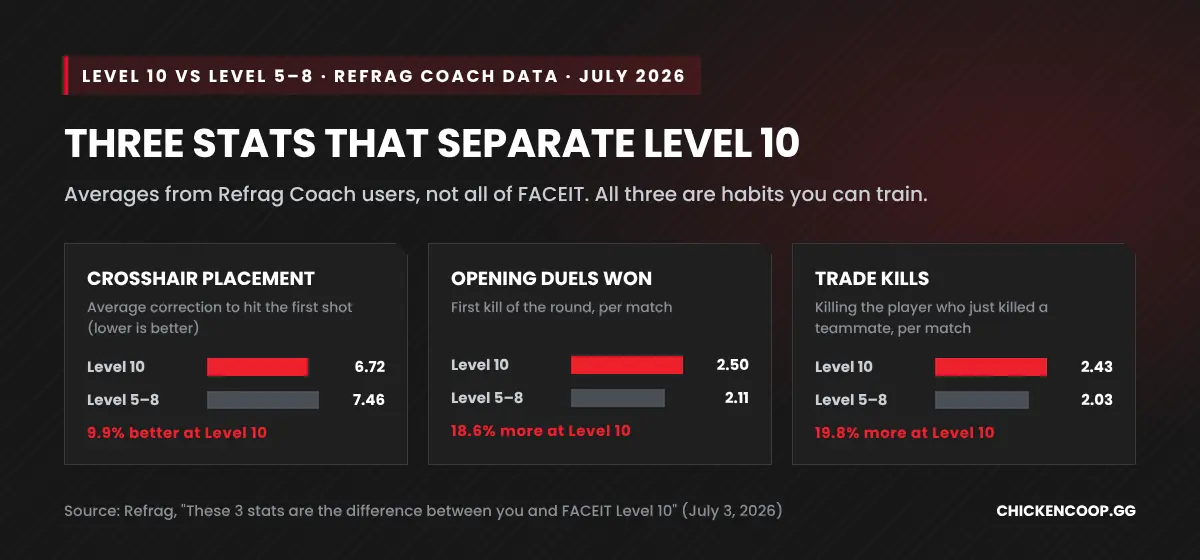
Crosshair placement is how far you have to move your aim to hit the first shot when an enemy appears; Level 10 players needed about 10% less correction. Opening duels are the first kill of a round, and Level 10 players won about 19% more per match. Trade kills, killing the player who just killed your teammate, were about 20% higher.
The useful part is that none of these is raw reaction time. They’re habits. Pre-aiming common angles, keeping your crosshair where an enemy’s head will appear before you clear the corner, fixes crosshair placement. Opening duels improve when you peek with a plan and a teammate instead of swinging wide into an angle alone. Trades come from playing close enough to a teammate to punish the player who kills them, which is why Refrag points players toward organized team play like ESEA.
A climbing plan for NA players
Do the math before you grind. Level 8 starts at 1,531 Elo and Level 10 at 2,001, a 470-point gap. If each game moves you about 25 Elo, that’s roughly 19 more wins than losses on the way to FACEIT Level 10. Across the 20 to 50 range CSDB.gg reports, it’s anywhere from about 10 to 24 net wins, and beating stronger lobbies pays more. That’s a reachable target, but only if the wins come from better habits rather than more hours.
We’d start with 15 to 20 minutes before you queue on crosshair placement and peeking drills, then play with a consistent party when you can. Trading and communication are much easier with people whose habits you know. Review one loss a week instead of every game, and look for the rounds where you died first without a trade.
Once you reach Level 10, track your NA ranking rather than your Elo. Challenger is decided by position, not a number, and once you’re inside the top 1,000 FACEIT shows you how far you trail the No. 1 player (FACEIT support). And when you’re ready for team play, take the step the stats point to: an ESEA team. Our ESEA guide explains how your team’s average FACEIT Elo decides where it starts. If you’re an NA player aiming for an organization, our Hatch Academy reads your level and Elo straight from your linked FACEIT account when you apply.