The Valve Regional Standings decide which Counter-Strike 2 teams get invited to tournaments, from the Majors (Valve’s two biggest events each year) down to the ESL Challenger League. For a North American roster below tier 1 (the top international level), they’re the difference between waiting for an open qualifier and getting a direct invite. This is how the points are calculated, where NA teams stand right now, and what a grassroots roster can actually do to climb.
Valve Regional Standings explained: what they are
The Valve Regional Standings, or VRS, are Valve’s official ranking of CS2 teams. Valve publishes them, along with the data and model files behind them, in a public GitHub repository, in three regions: Europe, the Americas and Asia (Valve on GitHub). North American teams are ranked in the Americas list alongside South American teams.
The standings matter because tournament organizers have to use them. Under Valve’s Tournament Operating Requirements, the rules for Valve-ranked events, a tier 1 event (the top international events) invites at least 20 teams straight from the VRS, starting at No. 1. A tier 2 event (the level below, where most NA pro and semi-pro teams play) that uses VRS invites must invite at least four teams, and only teams ranked outside the global top 12 (Pley.gg; CSDB.gg). That second rule is the one most NA teams care about: it keeps tier 2 invites for teams below the elite.
Organizers invite from the monthly snapshot that’s in force on their invite date, so the monthly update is the one to watch. Every 2026 snapshot so far, from January 5 to November 2, has been dated the first Monday of the month (Valve’s 2026 snapshot files).
How VRS points are calculated
The model works in two stages. First it gives every roster a starting score built from four factors. Then it runs a head-to-head pass over recent matches, which shifts points from losers to winners, with upsets moving more points and older matches fewer (Pley.gg).
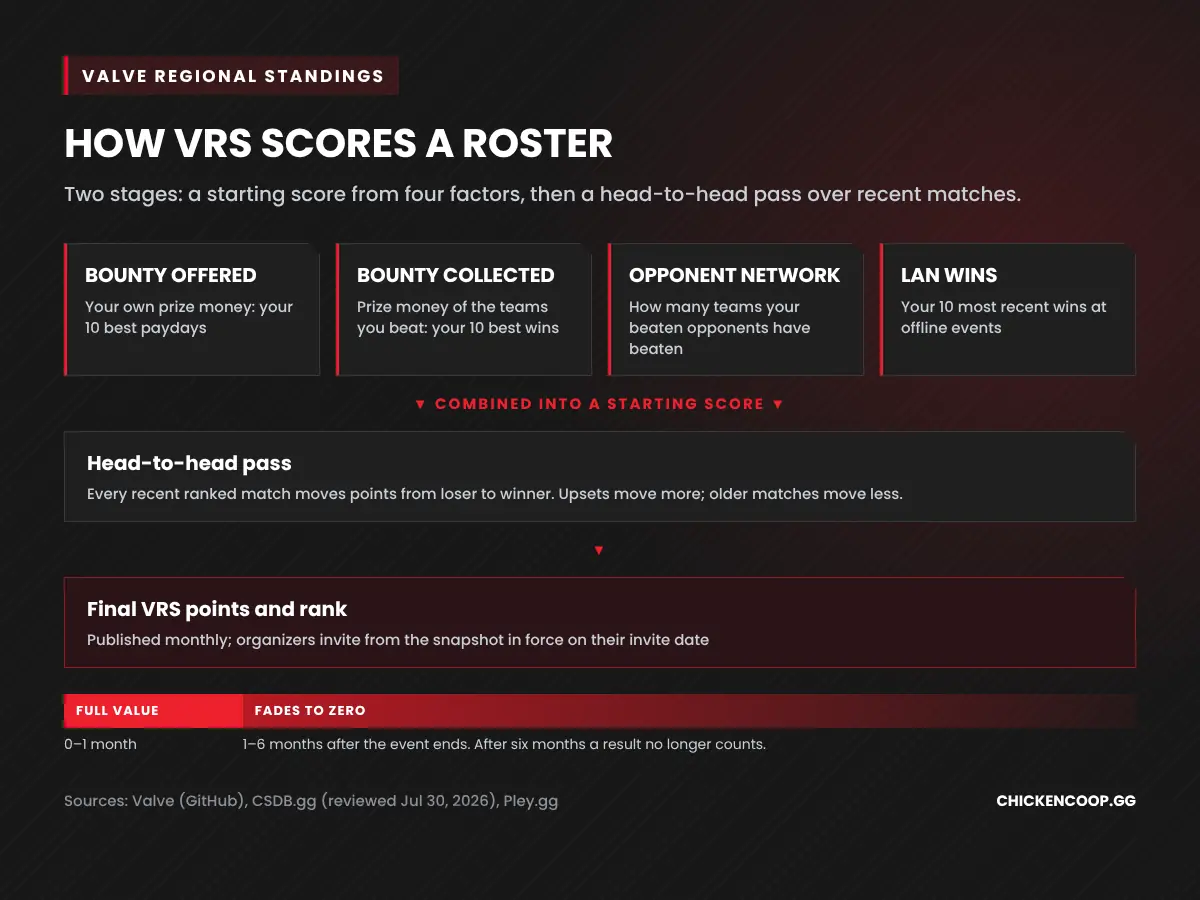
| Factor | What it measures | What it means for a grassroots team |
|---|---|---|
| Bounty offered | Your own prize money: your 10 best paydays from ranked events | Cashing at events counts, even small ones |
| Bounty collected | The prize money of teams you beat: your 10 best wins | Beating a team that’s been winning money is worth far more than beating a team that hasn’t |
| Opponent network | How many different teams your beaten opponents have beaten | Wins over well-connected teams matter; farming the same small pool doesn’t |
| LAN wins | Your 10 most recent wins at offline events | Showing up at LANs and winning series pays off directly |
Two details shape everything else. First, results fade: a result keeps its full value for about a month, then fades to zero over the next five months, so nothing older than six months counts (Pley.gg). Valve’s published model code applies that same age weighting to all four factors, with a six-month window and a one-month grace period (Valve’s model code). Second, only matches at Valve-ranked events count, prize pools are capped at $1,000,000 inside the model, and a roster needs at least one win to appear at all (CSDB.gg).
VRS ranks rosters, not organizations
Valve defines a roster as five specific players, whatever organization they play for. A lineup keeps its points only while at least three of those five stay together; change three players and the points don’t carry over. Invited teams also have to field at least three of the invited players in every match (CSDB.gg).
You can see this in the NA standings. In the November 2, 2026 snapshot, Iowa Stormboar and DETONATE each appear twice, once for each of two ranked lineups. For an amateur team, the lesson is that the points belong to the players. A roster shuffle can wipe out months of work, while an organization change with the same core keeps it.
Where North American teams stand
Here are the top NA rosters in the November 2, 2026 snapshot, with their points and their place in the Americas list. The data comes from Valve’s standings, which our site pulls each month.
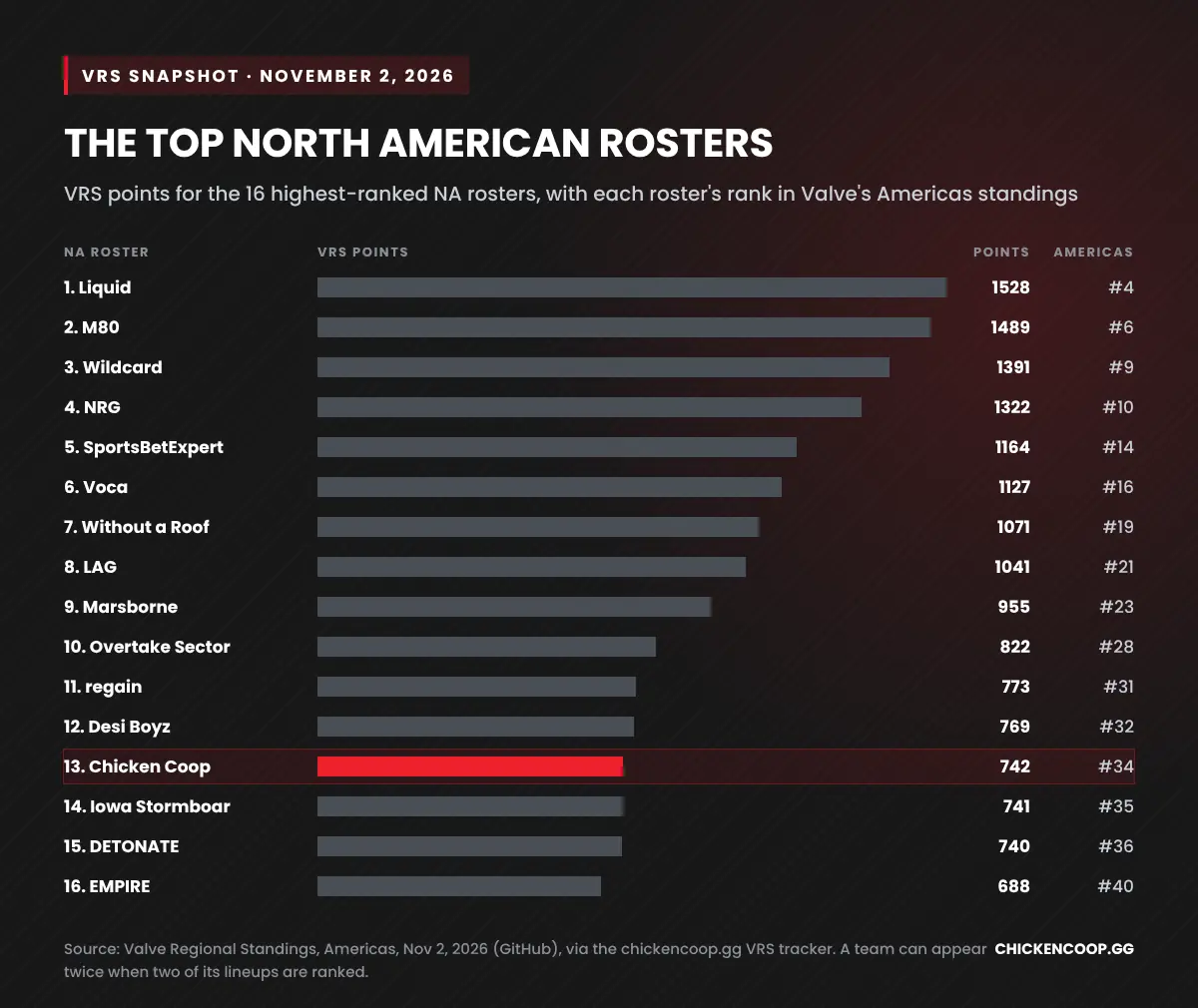
Two things stand out. The gap at the top is big: Liquid and M80 sit around 1,500 points, roughly twice what the teams from 11th to 15th have. And from 11th place down, rosters are packed tightly. Five NA rosters sat between 740 and 773 points, so a couple of good results moves a team several places.
What the standings mean for tier 2 invites in NA
The ESL Challenger League (ECL), ESL’s tier 2 competition and the step below ESL Pro League, is where VRS matters most for NA teams outside the top tier. Each North American ECL cup in Season 52 fills 14 to 16 places with VRS invites (Cups 1 and 4 keep two more for the top two of the ESEA NA Finals), and ESL ties each cup to a specific monthly snapshot (ESL Pro Tour).
The invite list goes deeper than the standings suggest. For ECL Season 52 Cup #1, ESL invited 14 NA rosters from the August 3 snapshot: Voca, Marsborne, NuTorious, Villainous Union, Iowa Stormboar, Zomblers, FarmVille, EMPIRE, Shimmer, Overtake Sector, DETONATE, Elusive, Incognito and Surge. ESL’s list of NA teams that declined their spot included Liquid, M80, Wildcard, NRG, SportsBetExpert and LAG. Rosters also have to keep a majority of their lineup to accept (ESL Pro Tour, August 19, 2026).
So the practical cutoff isn’t “top 14 in NA.” The best-known NA teams mostly turn the invite down (Liquid, M80, Wildcard and NRG all declined for Cup #1), and any roster that has lost its majority drops out. That pushes invites down to rosters like Elusive, Incognito and Surge, teams most fans haven’t heard of. A stable, ranked roster is closer to an ECL invite than it might think, and that’s the real reason to care about VRS if you run a grassroots team.
How a grassroots NA roster earns points
Everything comes back to winning at ranked events. For most amateur NA teams, three places do the work.
ESEA League is the most accessible. Since January 2026 ESEA League has been a VRS-ranked event from the Open9-10 group (NA’s lowest ranked group) up (FACEIT), with points coming from the matches HLTV, the main CS stats and news site, covers, according to Dust2.in. Our ESEA explainer walks through the groups and the NA Finals. The top two of each ESEA NA Finals also get ECL cup spots outright (ESL), which is how we reached ECL Season 52 Cup #1 after winning ESEA Season 57.
LANs, in-person events played on a local network rather than online, are the second. LAN wins are a factor of their own, and the opponent doesn’t have to be famous for them to count. When NIP won the Fragadelphia event in Las Vegas in spring 2025, Dust2.us reported a 43-place jump and 192 VRS points from six match wins, mostly against lower-ranked teams (Dust2.us). The model has been tuned since, so treat the exact numbers as an example. Our own run points the same way: by our count at the time, winning FRAG TAP Reloaded 2026 in Philadelphia was worth 184 VRS points and moved us from 32nd to 25th in the Americas (our recap). The direction holds: regional NA LANs like the FRAG series are one of the most efficient ways for a mid-table roster to move.
Ranked online cups and open qualifiers (qualifiers any team can sign up for) are the third. A win over a team with recent prize money and a wide opponent network can feed bounty collected and opponent network, even if you don’t go deep.
Points fade, so the calendar matters
Because results fade over six months, a big run only helps for so long. Our own VRS line shows it. Chicken Coop peaked above 1,000 points on the June and July snapshots, in a first half that brought four titles between January and June. We haven’t won an event since the ESEA Season 57 NA Finals on June 21, so those results have been fading, and we were down to 742 by November.
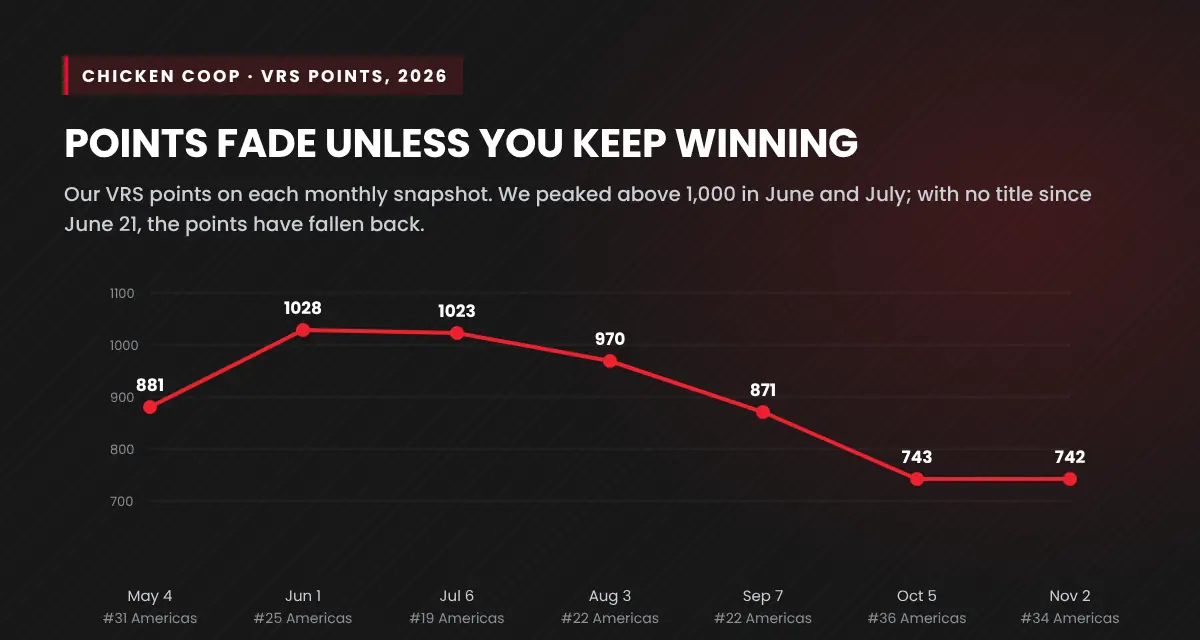
For planning, that means spreading results through the year beats one great month. It also means checking which snapshot an invite uses. ECL’s Cup #4 invites, for example, follow the November 2 snapshot plus the top two of the ESEA Season 58 NA Finals. We were 13th in NA on that snapshot, which puts us near the invite line once the top teams decline, so for us, and any team around 10th to 20th in NA, both routes are live.
A simple VRS plan for an NA team
Keep three core players together for the whole cycle. That alone protects your points and keeps you eligible for invites. Play ESEA in a ranked group, and treat the NA Finals as a direct shot at an ECL cup.
Pick a couple of NA LANs a year and go to win series, not just to attend. Enter ranked online events when your schedule allows; every win over a team with recent prize money counts more than you’d think. Then check Valve’s GitHub when each monthly snapshot is published. Our Results page tracks how Chicken Coop is doing.
If you’re a player rather than a team owner, the same logic applies to choosing a roster: a team with a stable core and a ranked ESEA spot is already on the ladder. Our Hatch Academy is built for players at that stage.