Most guides on how to get VRS points stop at the formula. This one opens the file Valve publishes for our own roster and reads it line by line: what each 2026 result added to Chicken Coop’s score, what each loss took away, and how fast it all faded. It’s written for North American teams playing ESEA (the open league run on FACEIT), ESL Challenger League cups (ECL, ESL’s tier 2 events, one level below the top international circuit) and regional LANs (in-person events), and for fans who want to know why a team’s ranking moved.
How to get VRS points: the short version from one NA season
VRS stands for Valve Regional Standings, the ranking Valve publishes every month and tournament organizers use to hand out invites. If the system is new to you, start with our VRS explainer for North American teams. This article is the worked example that follows it.
Here is what each kind of result was worth to us in 2026. The numbers come from Valve’s own files for our roster. They will differ for another team, but the proportions are the point.
| What happened | What it was worth to Chicken Coop |
|---|---|
| First prize money at a ranked event ($0 to $8,000) | About +177 points |
| A much bigger prize on top ($15,000 more) | About +29 points |
| One series win on LAN | About +48 points while it’s fresh |
| One online series win over a ranked NA roster | +3 to +26 points while it’s fresh (13 to 18 at our last cup) |
| One loss to Liquid or Wildcard (4th and 9th in the Americas) | −0.5 to −2 points |
| One loss to a roster nearer our own level | −7 to −26 points |
| Time | Every result is at full value for a month, then fades to zero by six months |
A series is one match between two teams, usually a best-of-three maps (Bo3). The rest of this article shows where each number comes from, so you can run the same check on your own roster.
Find your roster’s file and read the top of it
Valve keeps the standings in a public GitHub repository. Each monthly update, called a snapshot, has a standings page per region. North American teams are on the Americas list with South American teams, and every row ends in a “details” link.
That link is the file that matters. Ours for November 2, 2026 lists every match that counted, with the points each one moved.
The top of the file gives two numbers. The starting rank value is built from four factors: your own prize money (the file calls it Bounty Offered), the prize money of teams you beat (Bounty Collected), how many different teams those opponents have beaten (Opponent Network), and your wins on LAN (LAN Wins). Valve averages the four and stretches the result onto a scale that runs from 400 to 2,000. Then comes a head-to-head pass, which moves points between the two rosters in every match.
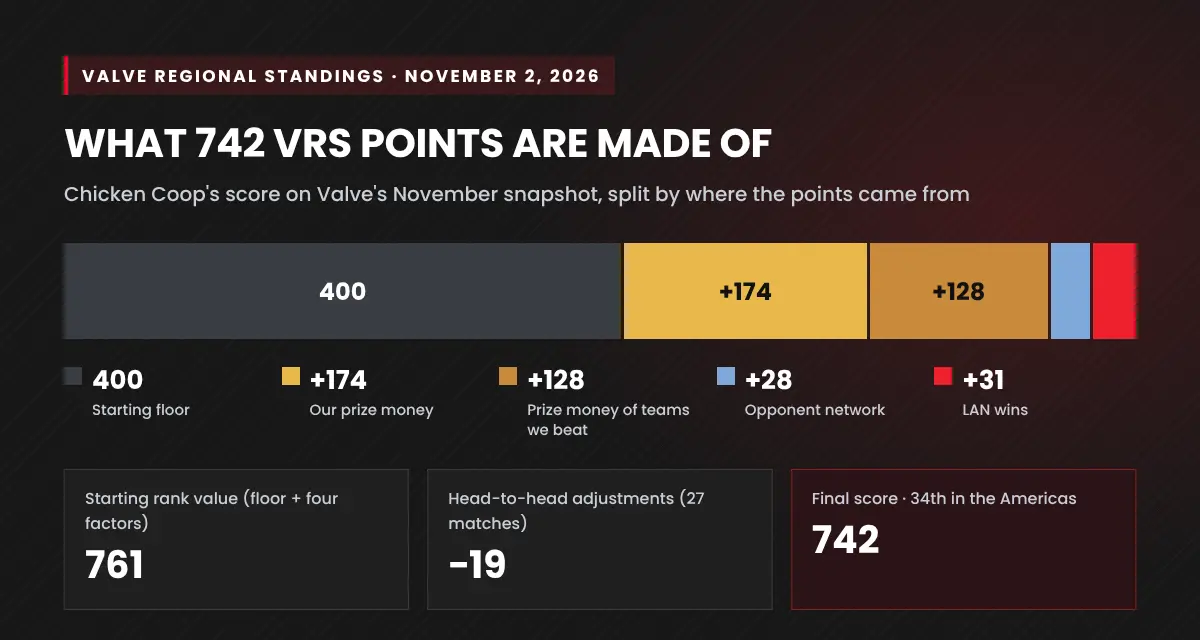
Because the four factors are averaged and scaled in a straight line, you can turn each one into points. On November 2, one full factor was worth about 468 points, so our prize money factor of 0.372 was worth about 174. Our whole score reads: 400 floor, plus 174, 128, 28 and 31 from the four factors, minus 19 from head-to-head, for 742 points and 34th in the Americas.
More than half of a mid-table score is the floor every ranked roster gets. The part you can change is small, which is why one good weekend moves a team so far, and why one bad month does too.
Prize money: the first dollars count most
On the March 2 snapshot our prize money factor was zero. Then we won ESL Challenger League Season 51 NA Cup 2 on March 27 for $8,000. On the April 6 snapshot the factor was 0.362, worth about 177 points by itself.
Our score went from 511 to 761 between those two snapshots. Our match report at the time counted 203 points for the cup alone; the snapshots are five weeks apart and include our other ranked matches in March.
In June we won the ESEA Season 57 NA Finals and $15,000 (reported by Dust2.us, the NA Counter-Strike news site), the biggest prize in our history. The factor moved from 0.349 to 0.414. That’s about 29 points for a prize almost twice the size of the first one.
The reason is in Valve’s model code. Your winnings are divided by the fifth-highest total among all rosters, then passed through a curve that flattens quickly. The November 2 files of other North American rosters show the same shape.
| Roster (Nov 2, 2026) | Prize money counted | Factor | Worth about |
|---|---|---|---|
| Iowa Stormboar (second lineup) | $697 | 0.257 | 120 points |
| Desi Boyz | $1,506 | 0.281 | 132 points |
| regain | $4,478 | 0.324 | 152 points |
| Chicken Coop | $11,191 | 0.372 | 174 points |
| Marsborne | $17,176 | 0.399 | 187 points |
| Liquid | $111,557 | 0.591 | 277 points |
“Prize money counted” is after Valve’s age weighting, so older winnings count for less than their face value. Liquid’s counted total is 160 times the smallest one in the table and buys 2.3 times the points.
For a roster with no ranked prize money, any paid finish at a ranked event is the cheapest large gain in this data. Chasing a bigger check after that helps far less than you’d expect.
A ranked event is one run under Valve’s Tournament Operating Requirements. Valve’s code drops matches that aren’t flagged as ranked, and each details file says its event data comes from HLTV.org, the main CS stats site. FACEIT explains what that means for its own leagues (FACEIT support).
LAN wins were the biggest swing of our year
The LAN wins factor counts up to ten series wins at in-person events, each weighted by age and then scaled against the fifth-best roster’s LAN record. The opponent doesn’t matter and neither does the prize pool.
At FRAG TAP Reloaded in Philadelphia on May 30 and 31 we won four series and $2,400. On the June 1 snapshot our LAN factor was 0.605, up from 0.205 a month earlier. That was worth about 288 of our 1,028 points, almost as much as the two prize money factors put together (299).
Each fresh LAN win was worth about 48 points. Dust2.us put it at “around 40 points” a win in its 2025 look at why LAN matches matter in the VRS.
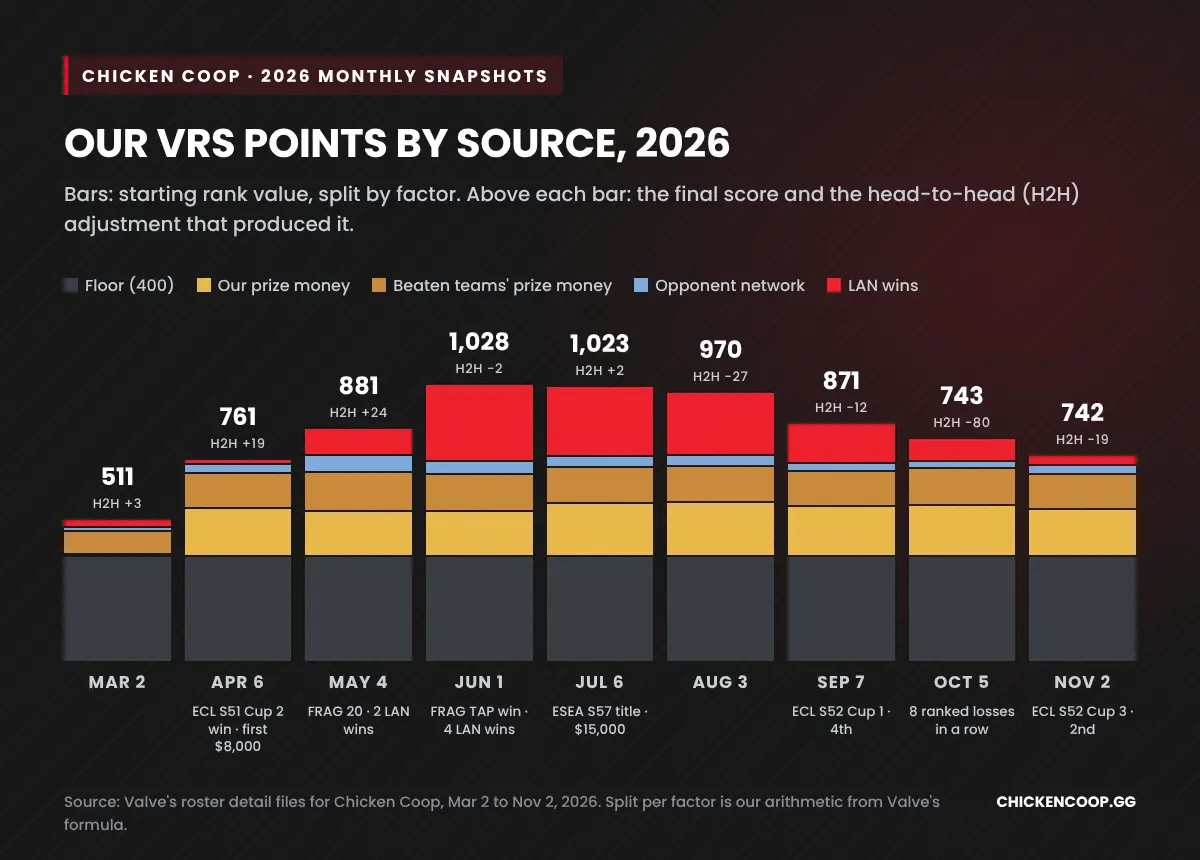
Compare the two titles. After a $2,400 LAN win we were 147 points higher on the next snapshot (our match report counted 184 for the event itself). The $15,000 online title three weeks later left us five points lower on the next snapshot, 1,023 against 1,028, because the new prize money only just covered what the older results had lost to age.
If your roster can travel to one event, an open regional LAN where you can win several series is worth more VRS than a deep run in a bigger online cup. Two series wins at FRAG 20 in Las Vegas in April were worth about 93 points on the May snapshot, and we won no prize money there.
What a loss costs, and who you lose to
None of the four factors goes down when you lose. Losses reach your score through the head-to-head pass, which works like a chess rating: the model compares the two rosters’ starting values, and the less expected the result, the more points move. Each match has its own line in the file, in a column headed “H2H Adj.”
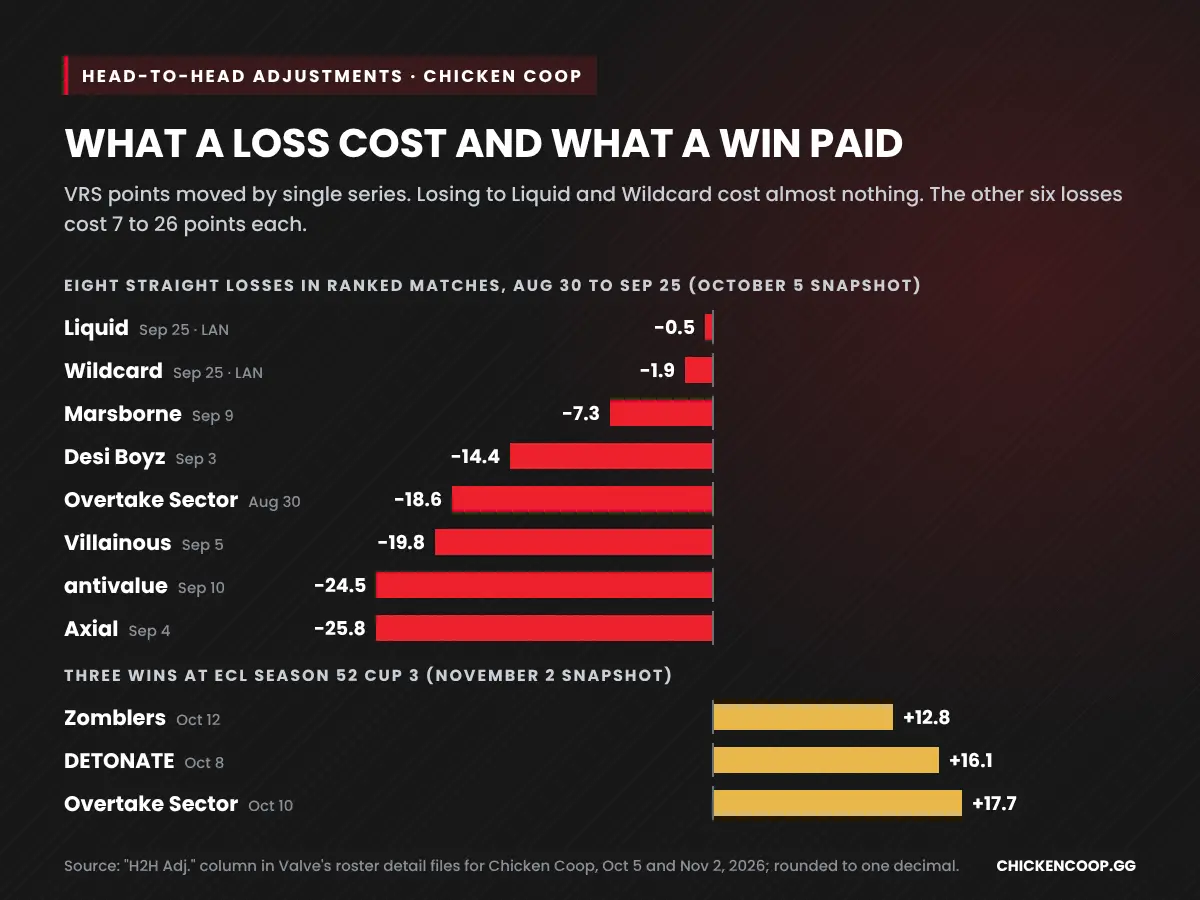
From August 30 to September 25 we lost eight ranked series in a row. On the October 5 snapshot the two losses to Liquid and Wildcard at fl0m’s Mythical LAN cost 2.4 points between them. The other six cost 110. Our head-to-head line that month was −80, and we fell from 22nd to 36th in the Americas.
Head-to-head also explains gaps the factors can’t. On November 2, Overtake Sector’s starting value was 746, lower than our 761. They finished on 822 and six places above us, because their head-to-head line was +76 and ours was −19.
Playing up is close to free, and playing a ranked match you’re expected to win is where the risk is. Don’t enter a ranked event with a lineup you wouldn’t trust against the teams below you.
Our 2026, event by event
| Event (dates of our matches) | Result | Score on the snapshots either side |
|---|---|---|
| ESL Challenger League S51 NA Cup 2 (online, Mar 20–27) | 1st, $8,000 | 511 → 761 |
| FRAG 20, Las Vegas (LAN, Apr 25), then ECL S51 Cup 4 | Top 8 at the LAN, two LAN series wins | 761 → 881 |
| FRAG TAP Reloaded, Philadelphia (LAN, May 30–31) | 1st, $2,400, four LAN series wins | 881 → 1,028 |
| ESEA Season 57 NA Finals (online, Jun 19–21) | 1st, $15,000 | 1,028 → 1,023 |
| ECL S52 NA Cup 1 (online, Aug 25–30) | 4th, $1,500 | 970 → 871 |
| Eight ranked losses in a row (Aug 30–Sep 25) | No wins; $1,000 at fl0m’s Mythical LAN | 871 → 743 |
| ECL S52 NA Cup 3 (online, Oct 8–14) | 2nd, $4,000 | 743 → 742 |
Placings and prize money are from our Results page. The last row is the one to notice. Second place at an ESL Challenger League cup, with three series wins and $4,000, kept us level for a month. Our four factors still lost 62 points that month as May and June aged, and the head-to-head line recovered by 61, from −80 to −19.
By November 2 the FRAG TAP wins counted at about a sixth of their value and the ESEA title at under a third. Valve’s code uses a 180-day window, so the FRAG TAP wins leave it on November 27 and the ESEA prize on December 18. Whatever the next snapshot says, those two results are nearly done working for us.
What we’d do with this if we were starting a season
- Open your roster’s details file on Valve’s 2026 standings folder after each snapshot and note the four factors. A zero is your cheapest gain.
- If your prize money factor is zero, enter ranked events where you can finish in the prize money. For most NA teams the nearest one is a ranked ESEA group, whose NA Finals pay prize money. FACEIT’s guide shows how to register a team.
- Budget for one or two open LANs and go to win series. FRAG lists its events and sells team passes on its own site, which showed no upcoming events when we checked on November 24, 2026. Dust2.us reported an $800 team pass and a sign-up deadline twelve days before FRAG TAP Reloaded.
- Count the dates. Find the snapshot your target invite uses (our ECL guide lists the one behind each cup), then work back: a result needs to be less than a month old to count in full, and one from five months earlier is nearly gone.
- Keep at least three of your five together. Valve’s model treats a lineup as the same roster only while it shares at least three players with the one that earned the results (Valve’s model code). On March 2 Valve listed two lines two places apart, 79th and 81st in the Americas: “ex-Chicken Coop” for a 2025 lineup and “Chicken Coop” for the roster we signed in January.
We haven’t won an event since June, and the file shows it more plainly than any ranking page. The December snapshot is expected on December 7, and our NA VRS tracker will carry the new numbers.