Valve slipped pet chickens into Counter-Strike 2 on September 22 without a single line in the patch notes. Since then, everything players know has come from the game files and from people raising their own birds. This guide covers how you get one, how long each stage lasts, every breed and what it costs you. It comes from a CS2 team named after a chicken, which made this one hard to resist.
The short version: CS2 chickens are account-bound pets. You can’t buy or trade them. A Chicken Egg can turn up in your Weekly Care Package, hatches in about a week, and grows through four stages over roughly five months. It needs Chicken Feed the whole way, and it leaves for good if the feed runs out. From the pullet stage it can follow you into matches.
How to get a CS2 chicken egg
There is one way in. You need Prime Status and your first profile level-up of the week, which unlocks the Weekly Care Package (the reward box that normally offers cases, skins and graffiti). Sometimes one of the offers is a Chicken Egg. It is random. It won’t show up every week, and Valve hasn’t published the odds.
Taking the egg uses both of that week’s reward picks, so you give up the case or skin you would otherwise have taken. The egg, the feed and the chicken are all untradable, so none of them has a market price. You can also only own one pet per account at a time.
Once you claim it, the egg appears beside your agent in the main menu, and its hatch date is set the moment you claim it.
The four stages, and how long each one lasts
Valve hasn’t published a timetable. Community trackers have read the stage lengths from the game files, and the first real birds have matched them so far: launch-night eggs hatched on September 28 and reached the pullet stage on October 20, 22 days later.
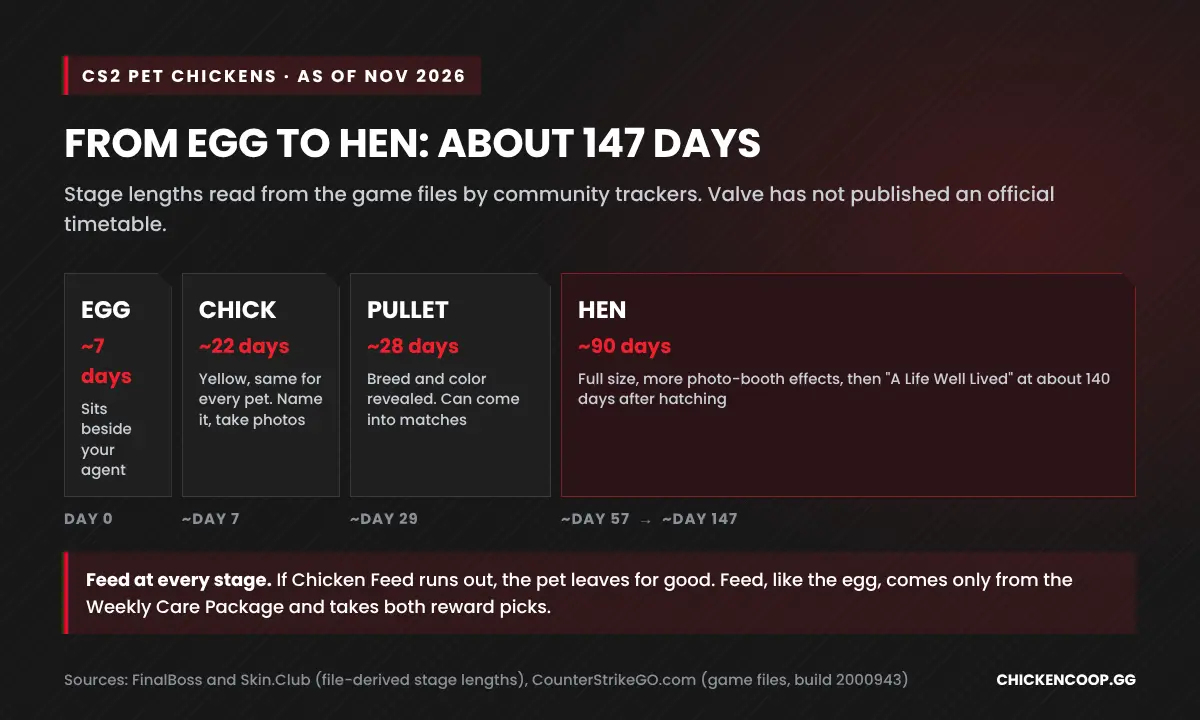
| Stage | About how long | What changes |
|---|---|---|
| Egg | 7 days | Sits beside your agent in the main menu. Needs feed to hatch. |
| Chick | 22 days | Yellow and identical for everyone. You can name it and use the photo booth. |
| Pullet (a young hen) | 28 days | Breed and color are revealed. It can now come into matches. |
| Hen | 90 days | Full size, with every photo-booth pose and effect. Then it leaves of old age. |
Those figures come from FinalBoss’s file-derived table: about 140 days from hatch, or about 147 days from the day you claim the egg. The game calls that ending “A Life Well Lived”. The first launch eggs should be reaching the hen stage around November 17, so the adult stage is only now being seen in real accounts. Treat the hen details as a reading of the game files until more players confirm them.
Feeding: the part that loses people their chicken
Chicken Feed comes from the same Weekly Care Package as the egg, and choosing it also takes both reward picks. Bags come in 4 lb and 8 lb sizes, and some packages offer two 8 lb bags. Valve hasn’t said how long a bag lasts; owners report about three weeks, which Valve hasn’t confirmed. The game sends a hunger warning and a notice before the food runs out. If you ignore them, the bird leaves for good with a message that it has “accepted a position elsewhere”. An egg whose food runs out doesn’t finish hatching.
This is the real cost of a CS2 chicken. Over five months you will spend several weekly drops on feed instead of cases or skins. If you only log in now and then, a missed warning can end the run. Raise one if you like the idea of a pet you look after; don’t take the egg expecting it to be worth anything later.
Every breed and color
There are three breeds, and a pullet’s breed and color are rolled for you. There is no way to pick or influence them.
- Catalana: a slim, classic farm-chicken shape, with the most color variants in every count.
- Polish: the one with the big feathered crest.
- Silkie: round, fluffy and soft-feathered, with variants like Leopard and Splash.
Sources disagree on the exact number of colors, and the difference is in how they count. Guides that list every color name reach 41 variants (15 Catalana, 13 Polish, 13 Silkie). Some of those lists mark several colors as not in the game yet. Sites that read the game’s files count 34 plumages (13 Catalana, 12 Polish, 9 Silkie). Neither is a Valve list. Until Valve publishes one, “between 34 and 41” is the honest answer.
Does your chicken come into matches?
Yes, once it is a pullet. Some guides say only a solo player or the lobby host can bring a pet, but players who read the game files say that rule covers only the main-menu scene, and the end-of-match screen shows every player’s pet. Early guides from launch week said the pet stayed in the menu, because no one’s bird was old enough yet.
Valve’s November 4 release notes (mirrored by Patchbot) say that pinging your pet chicken during freeze time asks it to do a trick. The September 22 notes, where the pets themselves went unmentioned, did say that chickens now take damage from the Zeus x27. Game-file readers say that a pet killed by fire, a Zeus or a planted C4 before the hen stage unlocks the matching photo-booth effect (Fire, Lightning or Explosion) and a page in its HatchBook, the pet’s photo album, early. From the pullet stage, finishing a match on official servers also unlocks that map as a photo-booth backdrop.
For a five-stack, the party rule applies to the menu lobby, not the match: nothing in the files limits a match to the host’s bird. If your team scrims or plays league matches on FACEIT, we found no source confirming pets appear on FACEIT’s servers. The map unlocks count official Valve servers only.
What our search data shows
We pulled US Google search volumes for chicken searches on November 15, through the same keyword tool that now feeds our SEO work. “Counter strike chicken” had an audience before the pets existed, 320 to 1,300 searches a month, and rose to 2,400 in September and October. “CS2 chickens” barely existed before September, then jumped to about 8,100 searches that month.
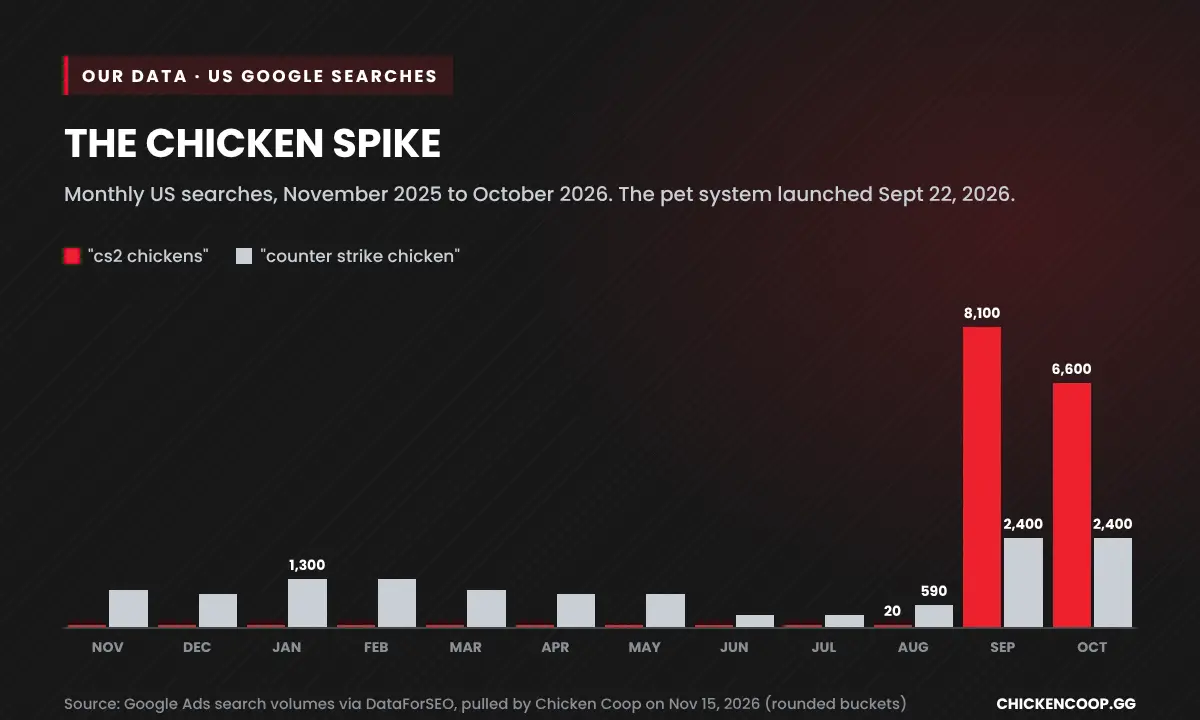
October stayed high at 6,600, and the questions changed. Broad searches like “cs2 pets” fell from 3,600 to 720, while searches for chicken colors and breeds went from about 30 a month to more than 100. People stopped asking what the chickens are and started asking what theirs turned into. With the first hens due this month, we expect that to continue. That’s our read of the data, not a forecast from Valve.
Why a team named Chicken Coop cares
The Coop takes its name from Chicken, the founder who pushed a family Counter-Strike habit into a real organization in Phoenix. We have been the chicken team in North American CS since 2024, before Valve gave everyone their own bird. This update is the first time “CS2 chicken” means something to every player, and we’ll keep this page current as Valve fills in the gaps.
If you’re climbing your own ladder while your pullet grows, our guide to FACEIT levels in North America is the more competitive read. Fans of the team can join the Coop, our free fan membership. Linking Discord lets you post in the members chat.